Cultural Globalization and Its Impact on Democratic Governance
Introduction
With the support of the internet and global transportation networks, the exchange of information has become convenient and fast. Popular culture is a good example, as it is spreading across the world at an unprecedented speed. For instance, Netflix productions such as Squid Game and Hellbound reached the top spot in more than 80 countries within 24 hours of release, showing an extraordinary level of simultaneity and global reach (Jin, Lee, & Hong, 2023).
Cultural globalization is undeniable and is gradually eroding global cultural diversity. However, this article argues that societies and cultures in different states are deeply rooted in their histories and values. Even when facing the same popular culture, they respond in different ways, so there are still boundaries between cultures and societies. This article also argues that the impact of transnational cultural exchange on democratic governance cannot be judged in a single way, as it has both positive and negative effects. Its positive effects are that cultural globalization may facilitate the diffusion of the universal values, facilitate the global integration of the political forces, and empower the civil society. Its negative effects are that cultural diffusion may propagate the false information, create the cultural domination, and expand the disparity. Therefore, governments and societies should respond according to their own national conditions.
This article is divided into three parts. The first part reviews past literature and presents the theoretical debates on this topic. The second part uses case studies to show that although cultural globalization exists, the core values of different cultures are difficult to change. The third part analyzes the impact of cultural globalization on democratic governance.
Theoretical Debates on Cultural Globalization
On the impact of transnational cultural exchange and cultural globalization, different theoretical perspectives and debates have long existed in academia.
Some scholars believe that national cultures will gradually merge. The optimistic view holds that different civilizations and cultures will blend with each other in the process of globalization, creating new civilizations or shared values. Mahbubani and Summers (2016), for example, introduce key concepts such as Fusion of Civilizations and Global Optimism. They argue that modern values will become a common goal, and that interdependence among states will reduce the possibility of conflict.
Other scholars take a more pessimistic view, arguing that cultural globalization harms cultural diversity and may even become a tool of power expansion. Rothkopf (1997) argues that the spread of American culture leads to the marginalization of local cultures. Schiller (2019) argues that cultural dependence and economic dependence reinforce each other, and that the United States is using Cultural Imperialism to promote capitalist values and strengthen its dominance in international society.
In contrast to the above views, some scholars argue that the differences between civilizations or cultures cannot be changed or bridged. Among them, Huntington’s (1993) clash of civilizations thesis is the most distinctive and representative. Huntington (1993) argues that civilizational differences cannot be removed and are hard to reconcile. Therefore, globalization and transnational cultural exchange will not promote integration but are more likely to cause conflict. He claims that future conflicts will take place along civilizational fault lines.
The transformationalist perspective and the global civil society perspective try to go beyond the views of either conflict or fusion and take a relatively neutral position. Held and McGrew (2003) argue that globalization is a multi-level and multi-dimensional process of transformation, in which state power is reconfigured. In cultural globalization, there are both forces of convergence and resistance, and the process involves localization and re-creation. Kaldor (2013) stresses the role of global civil society. She argues that global civil society can resist the logic of war through human rights movements, environmental protection, and transnational initiatives, and can provide new possibilities for global governance.
Overall, there are multiple explanations in academia about the impact of transnational cultural diffusion and globalization. Building on these debates, this article will further explore the trends of cultural globalization and its impact on democratic governance.
Cultural Convergence and Divergence
3.1 Cultural Convergence
In discussing the fusion of national cultures, popular culture is the most direct entry point. Since the beginning of the twenty-first century, Hollywood has not only been a model for the film industry but has also produced a large amount of global popular culture. Superhero narratives, because of their high level of cross-cultural comprehensibility, spread rapidly across the world after World War II. Countries such as Japan and India accepted this narrative and produced similar content (Hammonds, 2021). The influence is also two-way, as the preferences of global audiences have in turn shaped the choices of film producers. The share of action movies in Hollywood production has kept increasing, because action movies rely less on cultural context and perform better in the international market (Leung & Shi, 2023). The transnational spread of film culture shows the trajectory of popular culture in the process of cultural globalization.
Figure 1
Freedom House ratings: Percentage of free, partly free, and not free countries (1990–2024)
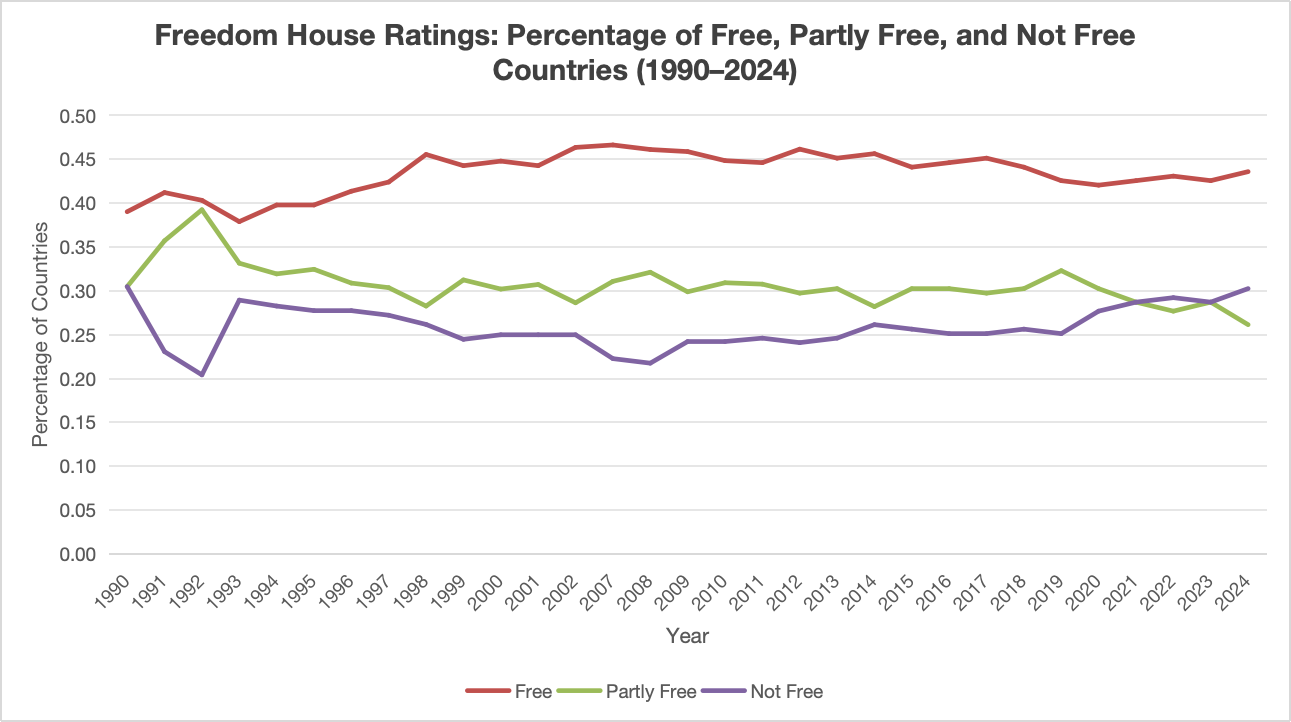
Note. Data from Freedom in the World 2024 dataset, Freedom House. Percentages represent the share of countries classified as free, partly free, and not free in each year.
Cultural globalization is also reflected in political ideas. Democracy and freedom spread rapidly as ideas in the 1990s. The United States and European Union countries reinforced the status of democracy and freedom through diplomacy and economic aid. Influenced by this trend, countries such as Poland and Hungary chose democratic transition, while some states in Africa and Latin America also moved toward political liberalization during this period through constitutional reforms and multiparty elections. According to Freedom House, the proportion of Free and Partly Free states rose after 1990 and then leveled off in the 2000s, while the number of Not Free states dropped sharply in the 1990s. National Human Rights Institutions also spread worldwide after 1990, showing that the theory of democracy and human rights had broad influence both in theory and in institutions (Pegram, 2010). This shows that cultural globalization also takes place in the political field and shapes the institutional choices and legitimacy-building of states.
The reasons for cultural globalization are not the sameness of national cultures or deep values, but the frequent flow of information and people, the demand for cost reduction and efficiency, and the pressure of international society.
First, revolutions in transportation and communication have made exchanges between states more frequent than ever before. Population flows through study abroad and the tourism industry have also accelerated cultural exchange and integration.
Second, cultural globalization also comes from the need to improve economic benefits and cooperation efficiency. From the perspective of the entertainment industry, using fixed narrative patterns and familiar visual symbols can speed up content production and reduce costs (Chalaby, 2016). From the perspective of national policy, economic globalization has led to the creation of unified market rules in the international community, pushing states to adopt similar institutional designs to increase cooperation efficiency. For example, the World Trade Organization promotes convergence in economic institutions through rules and institutional conditions.
Third, the pressure of international society also affects states. Some states adopt democratic and liberal ideas not because of their own history, culture, or development needs, but because of external pressure. Meyer, Boli, Thomas, and Ramirez (1997) argue that states design institutions under the influence of cultural scripts in order to align with global norms and gain international recognition and legitimacy. This also leads some institutions transplanted from the West to remain superficial in practice.
3.2 Cultural Divergence
The appearance of cultural globalization cannot change the histories, religions, and deep values of different cultures and societies, and boundaries still exist between them.
The appearance of cultural globalization cannot change the deep histories, religions, and values of different cultures and societies, and boundaries still exist between them. The exchange and integration of popular culture is two-way, as receiving countries also make choices and adaptations. Language is an important factor influencing cultural exchange. The circulation of television content is shaped by linguistic proximity. Broadcasters and audiences tend to prefer familiar languages, which leads to the formation of geolinguistic regions in the global television market and to regional differences in cultural consumption (Mast, De Ruiter, & Kuppens, 2017). States are not completely passive in the spread of global culture, since popular culture is localized when it enters domestic markets. Zhang and Li (2025) argue that in the process of remaking Hollywood films in Asia, Asian countries put local culture at the center while also linking it to global narratives, showing a case of cultural power inversion. Yomota (2019) points out that the history of Japanese cinema is one of interaction between global influence and local tradition. For example, Japanese yakuza films adopted the narrative frames and stylistic elements of gangster films but reshaped the plots with local values such as loyalty, obligation, and collectivism.
Deep values have an even stronger influence on politics, and the differences between political systems and political cultures are therefore more evident. Since the 1980s, the United States and European Union countries have promoted rule-of-law reforms in new democracies, but most projects remained superficial and did not touch the structure of power (Carothers, 2006). The original aim of the rule of law was to limit state power, but in some countries it became rule by law, which strengthened state governance instead. For example, in Egypt the Supreme Constitutional Court helped maintain international reputation and attract investment, but in politically sensitive cases it largely defended government power (Moustafa, 2007). This is because in Egypt’s history, state power has always been at the center of political order, and there has been no political culture of using an independent judiciary to limit the state.
Different countries also understand and apply the idea of democracy in different ways. In the Western context, democracy emphasizes equality, competition, and checks and balances, while in the Chinese context it highlights social harmony and stability (Lo, 2021). Western democracy is rooted in ancient Greek philosophy and shaped by historical events such as the Enlightenment and the Reformation, whereas Chinese democracy is deeply influenced by Confucian culture. Gao and Walayat (2023) propose Four Models of Compatibility and point out that Chinese democracy is a Hybrid Model. Traditional Confucian culture values social harmony and ethical order and stresses collectivism. As a result, in Chinese-style democracy, governance performance is the main source of legitimacy, and this has led to the development of consultative democracy with Chinese characteristics.
In the face of popular culture and political ideas, different countries respond in different ways. This is because, even under cultural globalization, traditional values remain resilient and stable. Inglehart and Baker (2000) use data to show that modernization brings value change, but history, religion, colonial experience, and social structures continue to have lasting influence. Therefore, cultural globalization does not necessarily lead to the disappearance of boundaries between cultures.
Implications for Democracy
4.1 Positive Implications
Although today’s cultural globalization cannot remove the deep differences between national cultures, it still has positive effects on democracy. This article argues that the positive effects of cultural globalization on democracy are mainly three: spreading democratic ideas, sharing democratic institutions, and promoting the development of civil society.
Spreading democratic ideas. In the spread of democratic ideas, cultural transmission plays an important role. Nye (2004) argues that culture is an important channel for the diffusion of national values. For example, during the Arab Spring, the Bouazizi incident triggered public anger over long-term authoritarianism and corruption. In Tunisia, people used the slogan “Freedom and Dignity” to force President Ben Ali to step down. As this slogan and idea spread widely on Facebook and Twitter, people in Egypt, Libya, Yemen, and other countries quickly responded, turning the demand for democracy in one country into a regional movement. Digital media created a “fourth wave” channel for the spread of democratic movements (Howard & Hussain, 2013). Although the impact of the Arab Spring was not entirely positive, it still shows the rapid spread of democratic ideas in the internet age.
Sharing democratic institutions. While spreading democratic ideas, cultural globalization also builds a set of legitimate institutional models in the international community. These models create legitimacy pressure on states, pushing them to adopt and learn democratic institutions such as judicial independence and electoral systems. This is because states are role-players embedded in the global cultural structure, and they imitate cultural scripts to increase their legitimacy (Meyer, Boli, Thomas, & Ramirez, 1997). Cultural globalization can also provide states with advanced democratic experiences, helping them reform their own democratic institutions. For example, in the 1990s, South Africa drew on the advanced experiences of countries such as the United States and Germany in its constitution-making process, abolished apartheid, and established a constitutional court.
Promoting the development of civil society. Keck and Sikkink (2014) propose the theory of Transnational Advocacy Networks (TANs). TANs can quickly produce information, spread universal symbols, and put pressure on governments through the international community, thereby increasing the influence of civil society. For example, the #MeToo movement began in 2017 after the Harvey Weinstein scandal in Hollywood and soon spread worldwide. It was not only a domestic social protest but also a transnational women’s political movement. As a shared symbol, #MeToo spread across many countries and linked the common demands of women in different contexts. The movement not only promoted the diffusion of ideas but also entered policy discussions in the United States and European countries (Stubbs-Richardson et al., 2024).
4.2 Negetive Implications
Cultural globalization can also have negative effects on democracy. This article argues that the negative effects of cultural globalization on democracy fall mainly into three areas: undermining local cultures, deepening inequality, and spreading misinformation.
Undermining local cultures. Because cultural globalization cannot change the deep differences between national cultures, the spread of democratic ideas also disrupts local traditions. Democratic ideas are often Western-led and presented as universal, but if they ignore a country’s history and religion, they may create social division and even unrest. For example, during the Arab Spring, Algeria embraced democratic ideals and held multiparty elections. However, democratic institutions did not match its local traditions of religious authority and military dominance. This mismatch led to more than ten years of civil war. When democratic ideas clash with local culture, they may trigger resistance and nationalism, weaken the spread of democracy, and bring social instability.
Deepening inequality. The globalization of entertainment content and popular culture is not only about circulation but also about a complete industrial chain. Chalaby (2016) points out that television programs are produced at the transnational level by different actors, but the United States and a few European countries dominate content and creativity. The core stages are concentrated in a few cultural powers, while peripheral countries are often left in low-value-added roles of production, distribution, or consumption. This surface-level cultural integration hides deeper cultural inequality. In terms of democracy, Western countries promote their own democratic values, and this one-way transmission constitutes cultural imperialism (Rothkopf, 1997). Non-Western states are then asked to measure their democracy according to Western definitions, losing the right to choose political systems suited to their own conditions and deepening inequality in discursive power.
Spreading misinformation. The internet has expanded the speed and scope of information across borders, but at the same time it has also provided channels for the spread of misinformation, conspiracy theories, and hate speech. During the 2017 Jakarta gubernatorial election, candidate Ahok mentioned the Qur’an in a speech. His rivals and religious conservatives accused him of “blasphemy against Islam.” As this content spread widely on the internet, amplified by media coverage and the circulation of false information, mass protests broke out, and Ahok was later sentenced to two years in prison. Sunstein (2001) argues that the internet can create echo chambers and group polarization, which eventually lead to the breakdown of public reason and a decline in democratic trust. Rapidly spreading information may also be used by external actors and authoritarian governments to harm democratic institutions (Howard & Hussain, 2013).
Conclusin
This paper mainly examines whether cultural globalization makes society and culture no longer defined by national borders, and analyzes the relationship between cultural globalization and democracy.
The first part summarizes the current literature and shows the varied accounts in the academy regarding the effect of cultural globalization. Some researchers contend that it can facilitate civilizational amalgamation and the establishment of shared values, whereas others highlight the fact that it can nullify cultural diversity and become an instrument of the augmentation of powers. Some identify civilizational variations are deeply ingrained and that strife is inevitable. Others highlight the fact that globalization is a multifaceted process of change, encompassing convergence and opposition, and holding promise for the first time for the governance of the globe.
The second section argues with case studies that while cultural globalization has introduced wide exchanges and interaction in popular cultures and political ideals, it has failed to remove fundamental differences between states. In receiving foreign cultures, nations tend towards selective absorption and localization. Meanwhile, history, religion, and social arrangements also remain in moldings and fashionings of the politico-economic systems and value orientations. Due to that, varied cultures attach varied meanings to terms like democracy and the rule of law.
The final part analyzes both the positive and negative effects of cultural globalization on democracy. On the one hand, it can be seen as spreading democratic ideas, sharing democratic institutions, and promoting the development of civil society. On the other hand, it may undermine local cultures, deepen inequality, and spread misinformation.
In the face of cultural globalization, the state should neither endorse it completely nor exclude it altogether. Rather, it should strike a balance between opening up and closing up in light of its own circumstances.
References
Carothers, T. (2006). Promoting the rule of law abroad: In search of knowledge. Carnegie Endowment for International Peace.
Chalaby, J. K. (2016). Television and globalization: The TV content global value chain. Journal of Communication, 66(1), 35–59.
Gao, S., & Walayat, A. J. (2023). Confucianism and democracy: Four models of compatibility. Humanities and Social Sciences Communications, 10, 79.
Hammonds, K. (2021). The globalization of superheroes: Diffusion, genre, and cultural adaptations. Oxford Research Encyclopedia of Communication. Oxford University Press.
Held, D., & McGrew, A. G. (Eds.). (2003). The global transformations reader: An introduction to the globalization debate (2nd ed.). Polity Press.
Howard, P. N., & Hussain, M. M. (2013). Democracy’s fourth wave? Digital media and the Arab Spring. Oxford University Press.
Inglehart, R., & Baker, W. E. (2000). Modernization, cultural change, and the persistence of traditional values. American Sociological Review, 65(1), 19–51.
Jin, D. Y., Lee, S., & Hong, S.-K. (2023). Netflix and the global receptions of Korean popular culture: Transnational perspectives. International Journal of Communication, 17, 6887–6896.
Kaldor, M. (2013). Global civil society: An answer to war (2nd ed.). Polity Press.
Keck, M. E., & Sikkink, K. (2014). Activists beyond borders: Advocacy networks in international politics. Cornell University Press.
Huntington, S. P. (1993). The clash of civilizations? Foreign Affairs, 72(3), 22–49.
Leung, T. C., & Shi, Q. (2023). Globalization and the rise of action movies in Hollywood. Journal of Cultural Economics, 47(1), 31–69.
Lo, L.-c. (2021). Decoding Xieshang Minzhu in Chinese politics: Chinese vs. Western conceptions of deliberative democracy. Chinese Journal of Political Science, 26(2), 317–332.
Mahbubani, K., & Summers, L. H. (2016). The fusion of civilizations: The case for global optimism. Foreign Affairs, 95(3), 126–135.
Mast, J., De Ruiter, K., & Kuppens, A. H. (2017). Linguistic proximity and global flows of television: A study with gatekeepers. International Journal of Communication, 11, 2562–2581.
Meyer, J. W., Boli, J., Thomas, G. M., & Ramirez, F. O. (1997). World society and the nation‐state. American Journal of Sociology, 103(1), 144–181.
Moustafa, T. (2007). The struggle for constitutional power: Law, politics, and economic development in Egypt. Cambridge University Press.
Nye, J. S., Jr. (2004). Soft power: The means to success in world politics. PublicAffairs.
Pegram, T. (2010). Diffusion across political systems: The global spread of national human rights institutions. Human Rights Quarterly, 32(3), 729–760.
Rothkopf, D. (1997). In praise of cultural imperialism? Foreign Policy, 107(Summer), 38–53.
Schiller, H. I. (2019). Communication and cultural domination. Routledge.
Stubbs-Richardson, M., Gilbreath, S., Paul, M., & Reid, A. (2024). It’s a global #MeToo: A cross-national comparison of social change associated with the movement. Feminist Media Studies, 24(6), 1330–1349.
Yomota, I. (2019). What is Japanese cinema? A history (P. Kaffen, Trans.). Columbia University Press.
Zhang, Y., & Li, W. (2025). Cultural power dynamics and narrative transformation: A comparative analysis of Hollywood film remakes in contemporary Asian cinema. Frontiers in Communication, 10, 1568170.