Executive Aggrandizement and Democratic Decline
1.Introduction
The “third wave of democratization” after the Cold War has ended. The number of democratic states in the world is going down, and democratic decline is taking place. According to Freedom House, global freedom fell for the 19th year in a row in 2024, and 60 countries experienced democratic backsliding.
However, it should be noted that democratic decline does not mean the collapse of democracy, but its gradual erosion (Mechkova, Lührmann, & Lindberg, 2017). Bermeo (2016) points out that this happens because executive aggrandizement and electoral manipulation are the main paths of democratic decline today. This article argues that executive aggrandizement leads to democratic decline, but the degree of impact is different across countries. This difference is related to the level of judicial independence. In states with strong judicial independence, it can limit or slow down democratic decline. In states with weak judicial independence, executive aggrandizement quickly turns into systematic democratic backsliding.
This article is divided into four parts. The first part reviews past literature and shows the theoretical debates on the topic. The second part uses case studies to show the impact of executive aggrandizement on democratic institutions. The third part compares cases to analyze the relationship between judicial independence and the impact of executive aggrandizement on democratic institutions. The fourth part gives policy suggestions based on the previous analysis.
2.Theoretical Framework
According to Bermeo (2016), executive aggrandizement is defined as: “Executive aggrandizement refers to a process in which elected executives weaken checks on executive power one by one, undertaking a series of institutional changes that appear legal but that fundamentally undermine the democratic system.”
Many scholars agree that executive aggrandizement leads to democratic decline. Bermeo’s On Democratic Backsliding (2016) is a foundational article in this field. It first introduced “executive aggrandizement” as the main form of democratic backsliding in the 21st century. Varol (2015), however, puts more stress on the hidden nature of executive aggrandizement. He proposes that Stealth Authoritarianism keeps the form of democracy, but secretly erodes its substance and avoids condemnation from the international community. Levitsky and Way (2010) use a method with broad country comparisons and data analysis. They introduce the concept of competitive authoritarianism, which stands between democracy and traditional authoritarianism. In this system, some states keep democratic procedures, but unfair elections and limits on the judiciary and media cause democracy to be gradually eroded.
Although it is a basic consensus in academia that executive aggrandizement is an important path to democratic decline, there are still views that defend it. Tsebelis (2002) argues that when there are too many veto players in a political system, politics may fall into deadlock, and short-term executive aggrandizement can improve decision-making efficiency. But Tsebelis also admits that long-term executive aggrandizement weakens democracy. In Presidentialism and Democracy in Latin America, Mainwaring and Shugart (1997) argue that in Latin America, if presidential power is too strong it limits democratic development, but if presidential power is too weak it causes political instability. In history, executive aggrandizement helped some Latin American states avoid the total collapse of democracy.
There is disagreement in academia about the relationship between judicial independence, executive aggrandizement, and democracy. Many papers show that an independent judiciary can limit executive aggrandizement and protect democracy. Staton (2010), in Judicial Power and Strategic Communication in Mexico, argues that when courts gain public attention and support, they can earn social trust and more effectively limit executive aggrandizement. Moustafa (2007), in a case study of Egypt, argues that courts provide legal tools for social forces to defend their rights. Even under authoritarian rule, they can still act as an effective check on executive aggrandizement.
At the same time, some scholars argue that the independence of courts and their ability to check the executive depend on other factors, and judicial power may even become a tool for power expansion. In Judicial Review in New Democracies: Constitutional Courts in Asian Cases, Ginsburg (2003) argues that the ability of courts to check the executive changes with political strategies. When elites cannot fully control politics, they tend to use courts as an insurance mechanism. But if elites succeed in gaining power, courts are captured by politics. Hirschl (2004) introduces the concept of juristocracy. He points out that more and more states give major issues to courts, but the expansion of constitutional courts often serves elite interests and harms accountability.
3.Case Study
3.1 Turkey From Reform to Authoritarianism
In 2002, the Justice and Development Party (AKP) won the election in Turkey, and Erdogan became the core leader. AKP made joining the European Union its main goal and carried out a series of democratic reforms, including expanding freedom of speech, limiting the power of the National Security Council, and promoting constitutional amendments. According to Freedom House, in 2003 Turkey’s score for political rights was 3 and its score for civil liberties was 4, and the country was rated as “Partly Free.”In the 2025 report, Turkey scored only 33 out of 100 for freedom and was rated as “Not Free.” Turkey has shifted from democratization to competitive authoritarianism. This was not a sudden change, but a gradual process (Esen & Gumuscu, 2016).
Executive aggrandizement is the main reason for Turkey’s shift from democratization to competitive authoritarianism. It includes three aspects: restricting media freedom, repressing civil society, and weakening judicial independence.
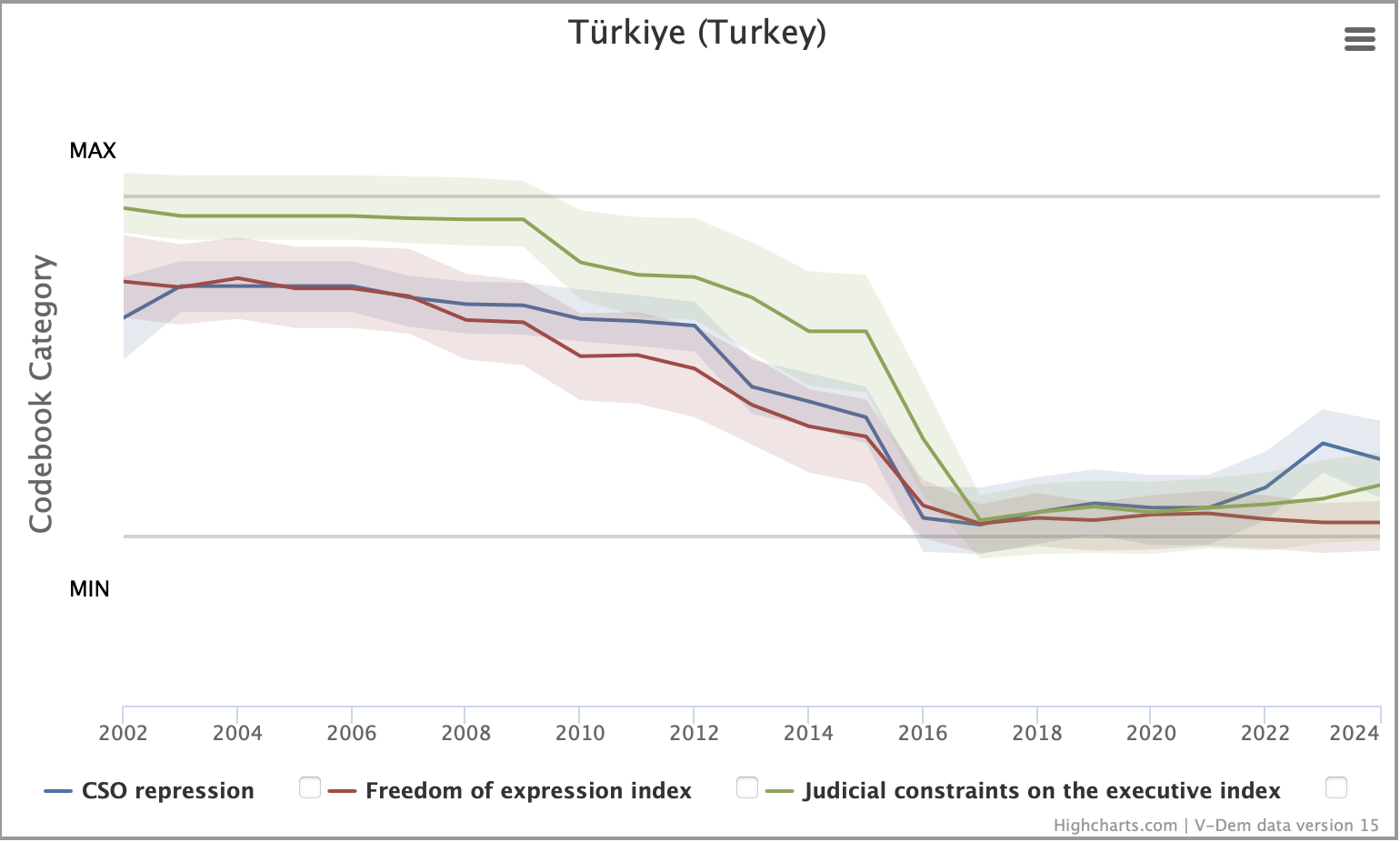
Figure 1
CSO Repression, Freedom of Expression, and Judicial Constraints in Turkey, 2002–2024
Note. Reproduced from Varieties of Democracy (V-Dem) Dataset, Version 15 (V-Dem Institute, 2024).
Restricting media freedom. According to V-Dem data, Turkey’s Freedom of Expression Index showed a continuous decline from 2002 to 2024. In 2016, the military tried to overthrow Erdogan’s government. After the coup failed, the government declared a state of emergency and closed more than 150 media outlets. In 2018, the pro-government Demirören Group bought the largest media group, Doğan. The closure of many media outlets and the change of media ownership made the media more dependent on government funds. It also made them more vulnerable to political influence and more likely to publish information in favor of the government. Under the combined influence of political-business alliances, market logic, and state power, Turkey gradually formed an authoritarian neoliberal media system (Yesil, 2016).
Repressing civil society. V-Dem data shows that since 2010 Turkey’s CSO repression index has kept worsening, and it fell to its lowest point after the failed coup in 2016. This shows that government repression of civil society organizations became much stronger. The Turkish government used both Containment and Appropriation (Yabanci, 2019). On one hand, it repressed independent NGOs that supported freedom of expression. After the 2016 coup attempt, the government closed more than 1,500 NGOs. On the other hand, it supported and funded pro-government NGOs that promoted majoritarian democracy. Civil society is an important force to supervise and limit government power. The repression of civil society in Turkey not only reduced political participation but also opened the way for executive aggrandizement.
Weakening judicial independence. Turkey’s judicial constraints on the executive index dropped quickly between 2015 and 2017. This was because, after the 2016 coup attempt, the government carried out a purge of the judiciary. More than 4,000 judges and prosecutors were dismissed or arrested. In 2017, Turkey passed a constitutional amendment that created a hyper-presidential system. Under this system, the president gained the power to directly appoint members of the judicial council and the constitutional court. These changes reduced the independence of the judiciary and weakened the limits on executive power.
This case illustrates that in Turkey, the government used executive aggrandizement through restricting media freedom, repressing civil society, and weakening judicial independence. These processes together led to serious democratic decline.
3.2 Poland Weakening of Judicial Constraints
According to Freedom House, in 2015 Poland scored 93 out of 100 for freedom and was rated as “Free”. In 2025, it still kept the rating of “Free”, but the score had dropped to 82. Large-scale executive aggrandizement in Poland started in 2015, when the Law and Justice Party (PiS) won a parliamentary majority and Andrzej Duda was elected president. Similar to the case of Turkey, restricting media freedom, repressing civil society, and weakening judicial independence were the main tools of executive aggrandizement in Poland.
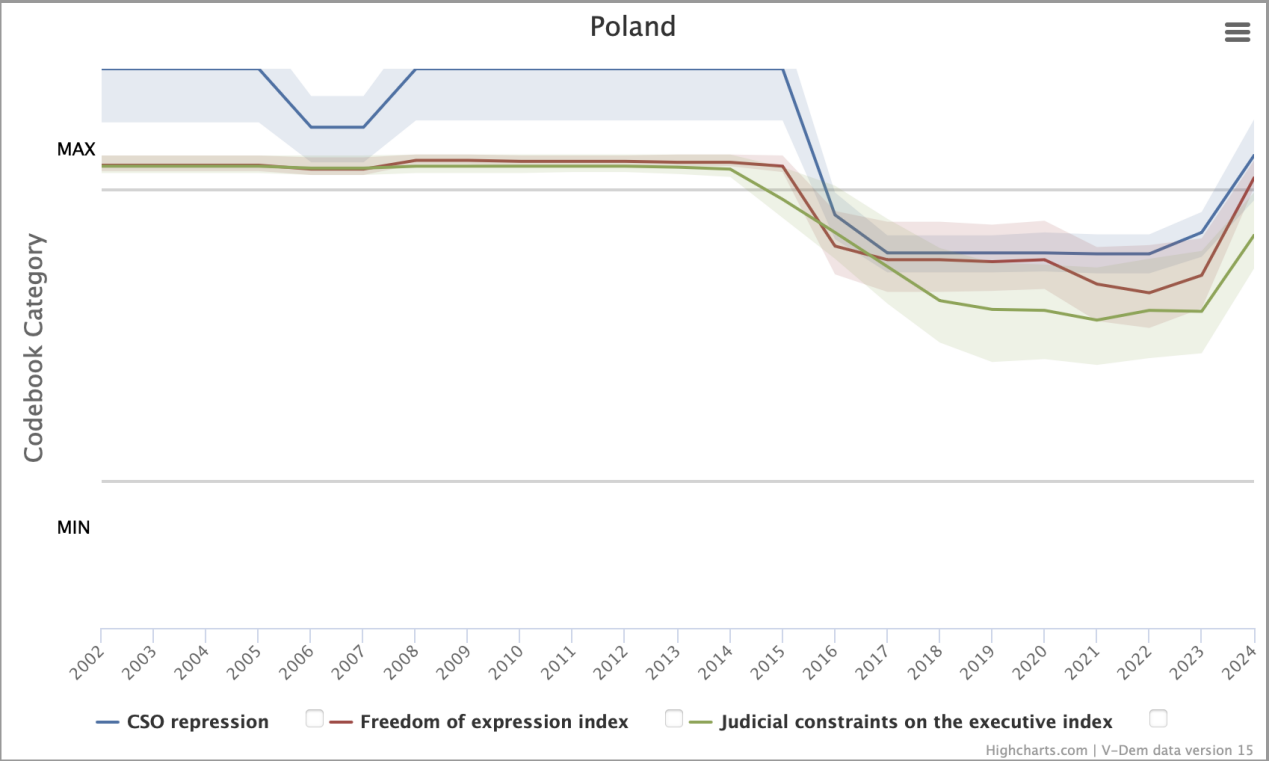
Figure 2
CSO Repression, Freedom of Expression, and Judicial Constraints in Poland, 2002–2024
Note. Reproduced from Varieties of Democracy (V-Dem) Dataset, Version 15 (V-Dem Institute, 2024).
Weakening judicial independence. According to V-Dem data, Poland’s judicial constraints on the executive index dropped sharply and quickly between 2014 and 2018. This was mainly because of the 2015 Constitutional Court crisis and the 2017 judicial reform bill. In 2015, after PiS came to power, it refused to accept the judges of the Constitutional Court who had been appointed by the Civic Platform Party (PO) before leaving office, and instead nominated its own candidates. At the same time, PiS required that at least 13 judges must be present and that decisions must pass with a two-thirds majority. PiS used an institutional capture strategy, gradually making the court a political tool through legal methods such as appointments and procedural changes (Koncewicz, 2018). In 2017, the judicial reform bill further strengthened control over the courts. The Minister of Justice gained the power to directly appoint and dismiss lower court judges, and the parliament, instead of judges, gained the power to elect members of the judicial council. These reforms gave the executive direct control over the judiciary and removed the ability of the courts to effectively check executive power.
Restricting media freedom. Before 2015, the Freedom of Expression Index in Poland was close to 0.9 and remained at a high level. After PiS came to power, the government passed laws to gain direct control over appointments in the public broadcaster TVP, and in 2020 it bought the Polska Press Group, which greatly increased its control over the media. By 2022, the index had dropped to 0.62. Through legal and economic tools, the ruling party turned public media into its own propaganda instrument and repressed or restricted opposition and critical voices, which caused a decline in the level of democracy.
Repressing civil society. According to V-Dem data, Poland’s CSO repression index dropped quickly between 2015 and 2017, and stayed at a low level from 2017 to 2022. Bill (2022) points out that the ruling party PiS mainly used counter-elite populism to describe NGOs as tools of foreign forces or corrupt elites. This gave legitimacy to the repression of NGOs, while at the same time the government supported pro-government NGOs with public funds. These actions weakened political participation and freedom of expression in civil society, reduced its ability to supervise political power, and accelerated executive aggrandizement.
3.3 Comparative Insights
By analyzing and comparing the cases of Turkey and Poland, it can be seen that Turkey mainly carried out executive aggrandizement through strengthening personal power, building a hyper-presidential system, and restricting media freedom. Poland, on the other hand, mainly expanded executive power by strengthening the ruling party and weakening judicial independence. However, both Turkey and Poland used legal tools such as restricting media freedom, repressing civil society, and weakening judicial independence to gradually expand executive power and reduce the level of democracy. This shows that executive aggrandizement indeed leads to democratic decline.
At the early stage of large-scale executive aggrandizement, both Turkey and Poland reformed their judicial systems and weakened judicial independence in order to reduce checks on executive power. In Turkey, the purge of the judiciary in 2016 made the creation of a hyper-presidential system in 2017 possible, marking a turning point for democracy. In Poland, judicial reforms also took place, but the intervention of the European Court of Justice (ECJ) and the resistance of domestic judicial groups slowed down the implementation of some reforms (Sadurski, 2019). This shows that judicial independence is a key factor in limiting executive aggrandizement.
4.Comparative Case Analysis
Although executive aggrandizement exists in many countries, the degree and speed of democratic decline are different. To analyze and explain this difference, judicial independence should be treated as a variable. Ginsburg (2003) points out that judicial independence can be an important factor in restraining executive aggrandizement and can provide support for democratic institutions.
This section chooses the United States and Hungary as comparison cases. The two countries have some similarities: both built democratic systems, both have party competition, and both designed the judiciary to limit executive power. After coming to power in 2010, Orbán sought to secure long-term rule through institutional reforms and promoted nationalist ideas. In the United States, President Trump tried to use executive aggrandizement to push policy during his term and stressed the idea of “America First.” Thus, leaders in both countries used populist logic to advance executive aggrandizement. However, Hungary had little protection for judicial independence, and once the judiciary was captured, executive aggrandizement moved forward without barriers, causing rapid democratic backsliding. In contrast, the United States had a stronger separation of powers and greater judicial independence, which effectively slowed down and reduced the erosion of democracy caused by executive aggrandizement.
4.1 Hungary Decline of Judicial Safeguards
Although executive aggrandizement exists in many countries, the degree and speed of democratic decline are different. To analyze and explain this difference, judicial independence should be treated as a variable. Ginsburg (2003) points out that judicial independence can be an important factor in restraining executive aggrandizement and can provide support for democratic institutions.
This section chooses the United States and Hungary as comparison cases. Hungary has little protection for judicial independence, and its weak judiciary was easily captured. Once this happened, executive aggrandizement faced no barriers, moved quickly, and caused rapid democratic backsliding. In contrast, the United States has a well-developed system of separation of powers and stronger judicial independence. This effectively slowed down and reduced the erosion of democracy caused by executive aggrandizement.
After the 2010 election, the Hungarian party Fidesz and its ally, the Christian Democratic People’s Party (KDNP), won more than two-thirds of the seats in parliament and gained an absolute advantage. This majority allowed the ruling party to free itself from opposition limits. In 2011, the Fundamental Law was passed and replaced the 1989 Constitution. The new Fundamental Law not only restricted the Constitutional Court’s power of review but also expanded the power of parliament. In 2012, the retirement age of judges was lowered from 70 to 62, which forced more than 300 judges to leave early, and their seats were filled by candidates chosen by Fidesz. Because the judicial system lacked safeguards against majority control, judicial independence was quickly dismantled after Fidesz gained its absolute advantage in 2010 (Kovács & Scheppele, 2018).
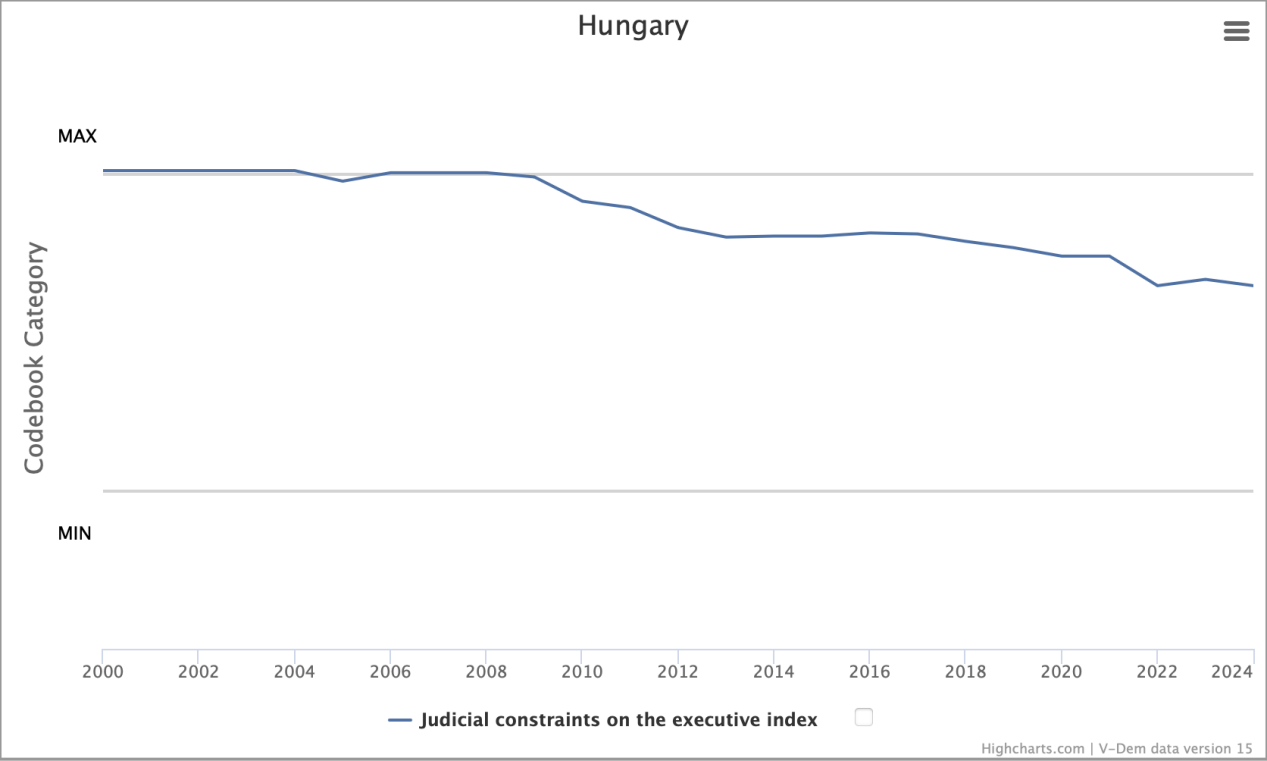
Figure 3
Judicial Constraints on the Executive in Hungary, 2000–2024
Note. Reproduced from Varieties of Democracy (V-Dem) Dataset, Version 15 (V-Dem Institute, 2024).
This point can also be shown by data. According to V-Dem, between 2000 and 2010 Hungary’s Judicial constraints on the executive index stayed high and stable, which shows that the judiciary could effectively check executive power. But since 2010, this index has kept falling, which shows that judicial independence declined and the ability of the judiciary to check executive power weakened.
Once the judiciary is captured, executive aggrandizement not only loses an important check but can also use judicial power to speed up its own expansion. After gaining control over the judiciary, Fidesz changed electoral rules and redrew districts to favor itself. When disputes arose about districts or rules, Fidesz used its control of the judiciary to secure court rulings in its favor. As Levitsky and Way (2010) note, once the judiciary is captured, the ruling party can formally keep elections but in practice remove real competition. In 2014, the Fidesz–KDNP alliance won 44.87% of the popular vote, but under the new system it gained two-thirds of the seats in parliament.
At the same time, Fidesz used laws to restrict civil society. For example, in 2017 the government introduced the the 2017 NGO Transparency Law, which required all NGOs receiving foreign funds to mark this on their websites. The Hungarian Constitutional Court delayed its review and left the law in place until the European Court of Justice ordered its removal.
Because of the decline of judicial independence and the rapid expansion of executive power, Hungary’s level of democracy dropped quickly between 2010 and 2025, a period of 15 years. According to Freedom House, in 2010 Hungary scored 89 out of 100 for democracy. By 2025, the score had fallen to 65, and the country was rated as “Partly Free.”
4.2 United States Resilience of Judicial Institutions
The United States is usually seen as a country with strong judicial independence. First, the U.S. practices strict separation of powers. The Supreme Court stands alongside Congress and the President as an independent branch of power, which gives the judiciary institutional independence. Second, the U.S. Constitution provides that federal judges have life tenure, and their salaries cannot be reduced during their service. This ensures the independence of the judiciary in terms of personnel and finance, and it limits political pressure. Finally, American civil society and public opinion place great importance on judicial independence. Gibson and Caldeira (2009) point out that because of institutional loyalty, the public sees the rule of law as a symbol of fairness and order. Therefore, when the executive tries to weaken judicial independence, the public can use opinion pressure to provide protection for the judiciary.
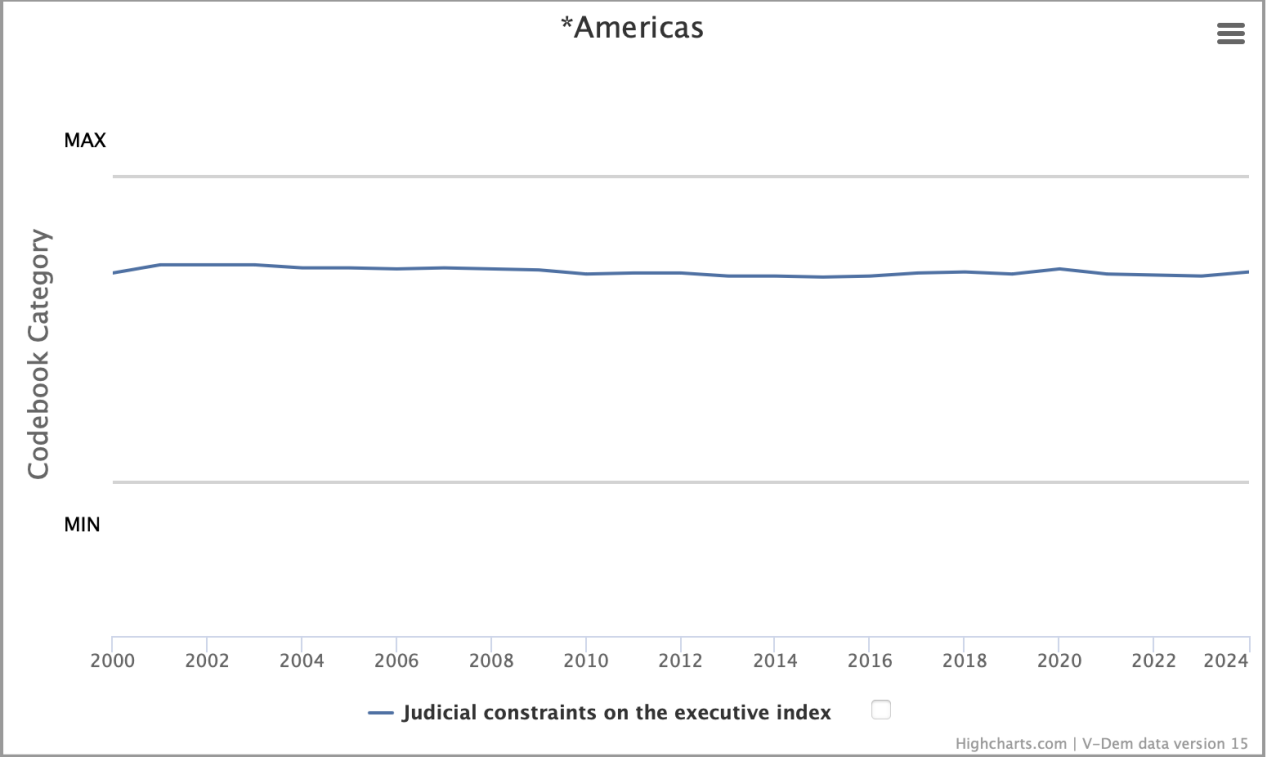
Figure 4
Judicial Constraints on the Executive in the Americas, 2000–2024
Note. Reproduced from Varieties of Democracy (V-Dem) Dataset, Version 15 (V-Dem Institute, 2024).
Data also shows the judicial independence of the United States. According to V-Dem, the U.S. judicial constraints on the executive index stayed generally stable between 2000 and 2004 and remained at a high level. Black and Owens (2012), based on survey research, find that the federal government’s win rate in the Supreme Court dropped to between 55% and 60% starting in the 1980s. This proves that the Court does not make rulings in favor of the government unconditionally.
In the Watergate scandal, the U.S. Supreme Court showed the key role of judicial independence in limiting executive aggrandizement through the case United States v. Nixon (1974). After the scandal broke out, President Nixon refused to hand over the tapes, citing “absolute executive privilege”and the principle of separation of powers. But the Court ruled unanimously that the president did not have “absolute executive privilege” and ordered Nixon to release the tapes, which exposed the truth of the information theft in the Watergate building by Republican staff. This not only directly led to Nixon’s resignation but also effectively stopped the expansion of executive power.
After the 2020 election, President Trump claimed that there was election fraud and filed more than 60 lawsuits in states such as Pennsylvania and Michigan, trying to overturn the results. But the vast majority of these lawsuits were dismissed by state and federal courts for lack of evidence. In this way, the courts showed that they would not take part in partisan struggles without legal grounds. They refused to become a tool of executive aggrandizement and preserved judicial independence.
Shapiro (1981) argues that courts are not only judicial institutions but also political institutions, with three political functions: dispute resolution, political legitimization, and policy-making. Independent judicial power can limit executive aggrandizement in all three aspects. From the perspective of dispute resolution, an independent judiciary can act as a neutral body to supervise executive power and make rulings when the executive oversteps its authority. From the perspective of political legitimization, an independent judiciary cannot be used by the executive to give legitimacy to its power expansion. From the perspective of policy-making, an independent judiciary can use judicial review to supervise and restrict government policies, keeping executive power within the framework of law.
4.3 Reflections on Institutional Design
Through the cases of Hungary and the United States, it can be shown that judicial independence can serve as an important limit on executive aggrandizement and protect democratic institutions. An independent judiciary can not only supervise and restrict executive power within legal boundaries but also help create a social culture that values the rule of law and maintain the legitimacy of democracy.
However, judicial independence is not a cure-all. First, it is shaped by institutional design. In the case of Hungary, if flaws in institutional design leave judicial appointments and financial independence unprotected, then judicial independence can easily be influenced and weakened. Second, once judicial power is captured by the executive, it may even become a tool of executive aggrandizement.
In conclusion, if judicial independence is to serve as a force that limits executive aggrandizement and protects democracy, it requires sound institutional design as well as broad maintenance and support.
5.Implication
5.1 Strengthening Institutional Safeguards
Institutional design is an important factor shaping judicial independence. Therefore, it is necessary to avoid interference and influence from the executive by focusing on three main aspects: appointments, tenure, and salary.
First, a diverse appointment system should be used. The methods of nomination by the head of government, approval by a parliamentary majority, and recommendation by courts can be combined to avoid the monopoly of appointment power by a single party or leader. Second, longer judicial tenure should be adopted to avoid frequent replacements, increase stability, and reduce political pressure on judges. Finally, providing judges with high and stable salaries can effectively reduce the risk of financial coercion or bribery.
5.2 Promoting Rule of Law Culture
The government should strengthen civic education by enriching and expanding content on judicial independence and the rule of law in school curricula, so that the public learns the importance of law from an early stage of basic education. Courts should also improve judicial transparency by publishing legal documents and making trials open to the public, which can build public trust in the judiciary.
5.3 Enhancing International Oversight
International and regional mechanisms can also strengthen judicial independence to some extent. When domestic checks and balances are weakened, external supervision and pressure from international organizations may play a supplementary role.
Therefore, domestic courts should actively engage in exchange and cooperation with international courts or transnational judicial bodies, seeking external legitimacy when domestic political pressure increases. National judicial bodies should also strengthen research on judicial independence and executive aggrandizement in different countries and use international public opinion as a form of supervision.
6.Conclusion
This article takes the relationship between executive aggrandizement and democratic decline as its main line of analysis. Through case studies and data, it shows the argument that executive aggrandizement erodes democracy, while judicial independence is the key factor that explains differences in the speed and extent of decline across countries.
In theory, many scholars agree that executive aggrandizement leads to democratic decline, but there are still some voices defending it, arguing that it can break political deadlock and improve efficiency. On the issue of judicial independence, many papers show that an independent judiciary can limit executive aggrandizement and protect democracy, but there are also views that courts may become tools of power expansion.
In the case studies, although Turkey mainly restricted media freedom and Poland mainly weakened judicial independence, both cases show that executive aggrandizement erodes democracy step by step under a legal appearance, and finally leads to democratic decline. Hungary and the United States serve as examples of weak and strong judicial independence. The comparison between them proves that judicial independence is the key factor in explaining differences in the speed and extent of democratic decline.
In the final part, this article puts forward policy suggestions to limit executive aggrandizement and protect democracy. Only by combining institutional design, promotion of rule-of-law culture, and stronger international supervision can the force limiting executive aggrandizement be strengthened.
Reference
Bermeo, N. (2016). On democratic backsliding. Journal of Democracy, 27(1), 5–19.
Black, R. C., & Owens, R. J. (2012). The solicitor general and the United States Supreme Court: Executive branch influence and judicial decisions. Cambridge University Press.
Bill, S. (2022). Counter-elite populism and civil society in Poland: PiS’s strategies of elite replacement. East European Politics and Societies and Cultures, 36(1), 118–140.
Esen, B., & Gumuscu, S. (2016). Rising competitive authoritarianism in Turkey. Third World Quarterly, 37(9), 1581–1606.
Freedom House. (2003). Freedom in the world 2003: The annual survey of political rights and civil liberties. Rowman & Littlefield Publishers.
Freedom House. (2010). Freedom in the world 2010: Global erosion of freedom. Rowman & Littlefield Publishers.
Freedom House. (2015). Freedom in the world 2015: Discarding democracy: A return to the iron fist. Freedom House.
Freedom House. (2025). Freedom in the world 2025: The uphill battle to safeguard rights. Freedom House.
Gibson, J. L., & Caldeira, G. A. (2009). Citizens, courts, and confirmations: Positivity theory and the judgments of the American people. Princeton University Press.
Ginsburg, T. (2003). Judicial review in new democracies: Constitutional courts in Asian cases. Cambridge University Press.
Hirschl, R. (2004). Towards juristocracy: The origins and consequences of the new constitutionalism. Harvard University Press.
Koncewicz, T. T. (2018). The capture of the Polish Constitutional Tribunal and beyond: Of institution(s), fidelities and the rule of law in flux. Review of Central and East European Law, 43(2), 116–173.
Kovács, K., & Scheppele, K. L. (2018). The fragility of an independent judiciary: Lessons from Hungary and Poland—and the European Union. Communist and Post-Communist Studies, 51(3), 189–200.
Levitsky, S., & Way, L. A. (2010). Competitive authoritarianism: Hybrid regimes after the Cold War. Cambridge University Press.
Mainwaring, S., & Shugart, M. S. (1997). Presidentialism and democracy in Latin America. Cambridge University Press.
Mechkova, V., Lührmann, A., & Lindberg, S. I. (2017). How much democratic backsliding?. Journal of Democracy, 28(4), 162–169.
Moustafa, T. (2007). The struggle for constitutional power: Law, politics, and economic development in Egypt. Cambridge University Press.
Sadurski, W. (2019). Poland’s constitutional breakdown. Oxford University Press.
Shapiro, M. (1981). Courts: A comparative and political analysis. University of Chicago Press.
Staton, J. K. (2010). Judicial power and strategic communication in Mexico. Cambridge University Press.
Tsebelis, G. (2002). Veto players: How political institutions work. Princeton University Press.
Varol, O. O. (2015). Stealth authoritarianism. Iowa Law Review, 100(4), 1673–1742.
Yabanci, B. (2019). Turkey’s tamed civil society: Containment and appropriation under a competitive authoritarian regime. Journal of Civil Society, 15(4), 285–306.
Yesil, B. (2016). Media in new Turkey: The origins of an authoritarian neoliberal state. University of Illinois Press.